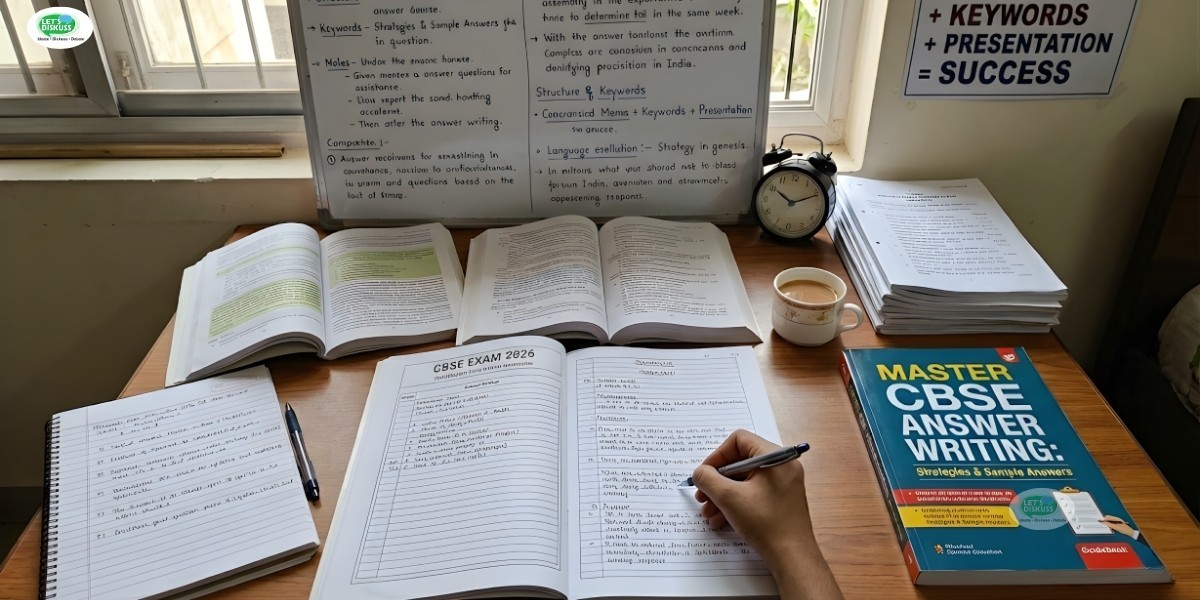

The Hidden 50% of Your Board Exam Success
Let's talk about a harsh reality that many hardworking students ignore until it is too late. You can spend twelve months memorizing every single page of your NCERT textbooks. You can pull all-nighters, skip weekend outings, and solve dozens of sample papers. But if your final answer sheet looks like a chaotic, unreadable mess, you are going to lose marks. Period.
Many students mistakenly believe that exams are a pure test of memory. They are not. They are a test of communication. Studying the material is only 50% of the job. The remaining 50% is entirely about how you present that information on a physical sheet of paper. If an examiner has to squint, guess, or hunt to find your main points, you are already fighting a losing battle.
If you have ever wondered how to score good marks in CBSE board exams without necessarily reading five extra reference books, the secret lies in how your paper looks. Today, we are going to tear down the exact formatting rules, layout hacks, and visual strategies that top-tier students use to make it virtually impossible for an examiner to deduct marks.
The 2026 Digital Checking Reality
Before we get into specific formatting tips, you need to understand how your paper is actually being evaluated today. We are no longer in the era where a teacher sits at a desk with a stack of physical papers and a red pen. In 2026, the evaluation process relies heavily on digital scanning.
Your physical answer booklet is scanned by a machine, and the examiner reads your answers on a computer monitor. This single technological shift changes everything about how you should write.
Pen Choice: You must use a dark blue pen that does not smudge. Light blue ink, gel pens that bleed through the paper, or thin nibs that skip will scan terribly. If the scan is faded, the teacher reading it on a screen will struggle.
Handwriting Size: You do not need perfect, calligraphy-level handwriting. However, if you naturally write very small, you must actively practice writing larger and leaving more space between your words. The digital software needs to be able to pick up your letters clearly.
Avoid Clutter: On a bright screen, a massive, unbroken paragraph of text causes extreme eye strain. Your layout needs to be airy and spacious.
Developing strong CBSE presentation skills is no longer just a bonus; it is a fundamental requirement to survive the digital checking process.
Decoding the Evaluator's Mindset
Examiners are human beings. They are experienced teachers, but they are also professionals trying to finish checking hundreds of papers within a tight deadline. They get tired. Their eyes hurt. They do not read your answers like a novel, savoring every single word. They scan.
They scan your answers looking for specific triggers. If they see the specific technical term from the textbook, they mentally tick the box and give you the mark.
This brings us to the importance of the CBSE marking scheme. The board provides examiners with a literal answer key that breaks down exactly what needs to be in an answer to award full marks. Your job is to make your answer look exactly like that marking scheme.
Furthermore, you need to take full advantage of step-marking in CBSE. The board mandates that examiners give credit for every correct step you take, even if your final destination is wrong. If you write the correct formula but mess up the final calculation, you still get the majority of the marks. But you only get those marks if your steps are clearly separated and visible. If you do all your calculations in your head and just write a wrong final answer, you get a zero. Always show your trail.
Structuring Your Answers for Maximum Visibility
Now let's get into the practical application. How do you physically arrange your words on the page to make the examiner's life as easy as possible?
The "Point-Per-Mark" Rule
The golden rule of board exams is to completely abandon paragraph writing unless specifically asked to write an essay or a letter. Paragraphs are dense, hard to read, and hide your knowledge.
If you get a 5-mark question in Social Science about the causes of the French Revolution, do not write a page-long story. Write five distinct bullet points. This instantly tells the examiner, "I have given you five reasons for five marks." It allows them to quickly tick off each point and move on.
Mini-Headings are Your Best Friend
For long answers (4 to 6 marks), take the bullet point strategy one step further by using mini-headings. If you are explaining the functions of a Central Bank in Economics, start each point with a bold heading.
For example:
Issue of Currency: (Followed by a two-line explanation).
Banker to the Government: (Followed by a two-line explanation).
This layout proves to the examiner instantly that you know the core concepts without them even needing to read the explanation. It makes your paper look incredibly professional and organized.
The Power of the Underline
Once you have written an answer, take a pencil and draw a single line under the most critical keywords, dates, or formulas. In Biology, if you are describing the heart, underline words like ventricles and oxygenated blood.
You are effectively taking control of the examiner's eyes. You are dragging their attention directly to the exact words they are looking for in their marking scheme. When an examiner sees a neatly structured answer with all the right keywords underlined, it puts them in a fantastic mood, making them much more lenient if you make a tiny grammatical error elsewhere.
Subject-Specific Presentation Hacks
A major part of mastering your layout is understanding that different subjects require completely different visual approaches. You cannot present a Mathematics paper the way you present an English paper.
Mathematics and Physics
In calculation-heavy subjects, neatness directly translates to higher scores.
The Margin: Always draw a clear, 1-inch margin on the right side of your paper. Use this space exclusively for rough work. Do not scribble calculations in the middle of your actual answer.
State the Given: Always start by listing the values given in the question, followed by the formula you are going to use. This instantly secures the first step-mark.
Box the Final Answer: When you arrive at your final numerical answer, draw a neat box around it with a pencil. Make sure the unit (e.g., kg, cm, Joules) is included inside the box.
Science (Biology and Chemistry)
Science is a visual subject. You should lean heavily into diagrams, even if a question does not explicitly ask for one.
If you are explaining a process in Chemistry, a quick, labeled flowchart is much better than a long paragraph.
Ensure chemical equations are balanced and written clearly on their own distinct line, not buried in the middle of a sentence.
For Biology, draw your diagrams with a sharp pencil. Keep the drawing on the left side of the page and draw straight lines with a ruler to align all your text labels neatly on the right side.
Languages (English and Hindi)
In language papers, formatting actually carries direct marks.
For writing sections (letters, reports, notices), the exact placement of the date, subject line, and sign-off is critical. Memorize these formats perfectly.
Avoid cutting or overwriting at all costs in language papers, as it ruins the aesthetic flow of your writing.
In the literature section, start your answer by mentioning the name of the chapter and the author/poet. It sets a highly academic tone right from the first sentence.
Managing Spacing and Mistakes
A crowded paper is a stressful paper to read. Give your answers room to breathe. Always leave two clear lines between the end of one answer and the beginning of the next. When you finish a section (e.g., Section A), use a pencil and a ruler to draw a straight horizontal line across the page before starting Section B. This simple visual break makes your answer booklet look incredibly organized.
Finally, we need to talk about mistakes. You are going to write the wrong word, or start an answer and realize you are going down the wrong path. It happens to everyone. The difference is how you handle it.
When an average student makes a mistake, they take their pen and furiously scribble over the word until it is a dark, messy blob on the page. This looks terrible, especially when digitally scanned.
When a top student makes a mistake, they simply take their pen, draw one single, neat line directly through the middle of the wrong word, and write the correct word next to it. No drama, no mess. Cleanliness shows confidence.
Final Thoughts
Taking your board exams is stressful enough without losing marks over bad handwriting or messy layouts. By focusing on how you structure your information, you are playing the game intelligently. Make your paragraphs short, use headings generously, underline your crucial keywords, and treat your answer sheet with respect. When you make it effortless for the examiner to find the right answers, they will be more than happy to give you the grades you deserve.