
Growth in the global aerospace data recorders industry is being driven by fleet modernization, regulatory upgrades, and the integration of advanced digital monitoring solutions. Known as black boxes, these systems gather detailed flight information and cockpit audio to support compliance, safety improvements, and operational transparency.
Aerospace Data Recorders Market Size, Trends & Opportunities by 2034
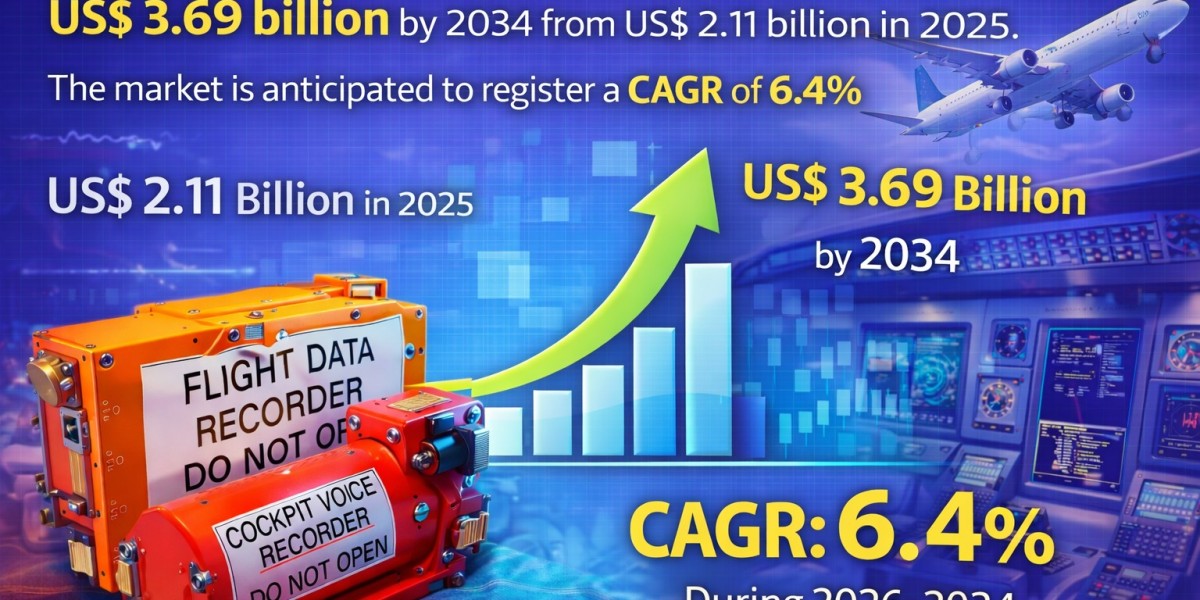
The global Aerospace Data Recorders Market is poised for steady expansion, with market size projected to grow from US$ 2.11 billion in 2025 to US$ 3.69 billion by 2034, registering a CAGR of 6.4% during 2026–2034. This growth is underpinned by increasing aircraft deliveries, stricter aviation safety regulations, and rapid technological advancements in flight data monitoring and real-time streaming systems.
Market Overview
Aerospace data recorders commonly referred to as “black boxes” play a critical role in ensuring aviation safety and operational transparency. These devices capture essential flight parameters, cockpit voice recordings, engine diagnostics, and system performance data. Regulatory authorities such as the FAA and EASA mandate the installation of cockpit voice recorders (CVR) and flight data recorders (FDR) across commercial and military aircraft fleets.
The market is evolving beyond traditional crash-survivable storage systems toward integrated, high-capacity solid-state recorders with cloud connectivity. Modern systems now enable real-time flight-to-ground data transmission, enhancing situational awareness and accelerating accident investigation processes. Additionally, data collected supports predictive maintenance strategies and Flight Operational Quality Assurance (FOQA) programs.
Request Sample PDF Here: https://www.theinsightpartners.com/sample/TIPTE100000694
Key Market Drivers
Rising Global Air Traffic and Fleet Expansion
The continuous growth of commercial aviation and the introduction of new aircraft models are driving demand for advanced line-fit and retrofit data recording systems.Stringent Safety Regulations
Updated regulatory mandates, including 25-hour cockpit voice recording requirements and ED-112A survivability standards, are pushing airlines to upgrade legacy systems.Technological Advancements in Data Streaming
The emergence of satellite-based data transmission and “black box in the cloud” capabilities is transforming traditional post-incident data retrieval into real-time monitoring systems.
Market Opportunities
Next-Generation Aircraft and eVTOL Platforms: Emerging urban air mobility systems require lightweight, compact, and low-power recording devices.
AI-Driven Predictive Maintenance Integration: Advanced analytics enable operators to detect anomalies early, reducing downtime and operational costs.
High-Capacity Lightweight Recorders: Aerospace weight-reduction initiatives are accelerating demand for miniaturized solid-state storage technologies.
Segmentation Insights
By Type
Cockpit Voice Recorders (CVR)
Flight Data Recorders (FDR)
Data Loggers
Quick Access Recorders (QAR)
By Application
Commercial Aircraft
Military Aircraft
Commercial aviation remains the dominant segment due to higher fleet volumes, while the military sector offers strong margins through specialized rugged and encrypted systems.
Regional Insights
North America holds the largest market share, supported by advanced aerospace infrastructure, strong defense budgets, and leading manufacturers.
Europe benefits from strict EASA compliance standards and investment in next-generation aerospace projects.
Asia Pacific is the fastest-growing region, driven by rapid fleet expansion in China, India, and Southeast Asia.
Middle East & Africa and South & Central America present emerging opportunities due to fleet modernization and infrastructure expansion.
Key Players in the Aerospace Data Recorders Market
Honeywell International Inc. (United States)
L3 Technologies, Inc. (United States)
Teledyne Technologies, Inc. (United States)
Curtiss-Wright Defense Solutions (United States)
Leonardo DRS (Italy/United States)
RUAG Holdings AG (Switzerland)
AstroNova Inc. (United States)
Universal Avionics Systems Corporation (United States)
FLYHT Aerospace Solutions Ltd. (Canada)
These companies compete through innovation in integrated recording systems, enhanced crash survivability, AI-based analytics, and cloud-enabled data recovery platforms.
Competitive Landscape
The market exhibits high competitive density with established aerospace OEM suppliers and specialized avionics technology firms. Companies are increasingly focusing on strategic partnerships, licensing agreements, and regulatory-compliant product launches. Recent collaborations between leading aviation manufacturers and recorder technology providers demonstrate the industry's shift toward advanced 25-hour CVR systems and connected recording platforms.
Future Outlook
Looking ahead, the aerospace data recorders market will increasingly transition toward fully connected, intelligent recording ecosystems. Real-time streaming, AI-powered predictive diagnostics, and secure encrypted data transmission will redefine safety and operational efficiency standards. The adoption of cloud-based storage, blockchain-enabled traceability, and lightweight solid-state systems will further enhance performance and regulatory compliance. As global air travel expands and next-generation aircraft platforms enter service, aerospace data recorders will remain central to aviation safety innovation and digital transformation across commercial and defense sectors.
Related Reports: