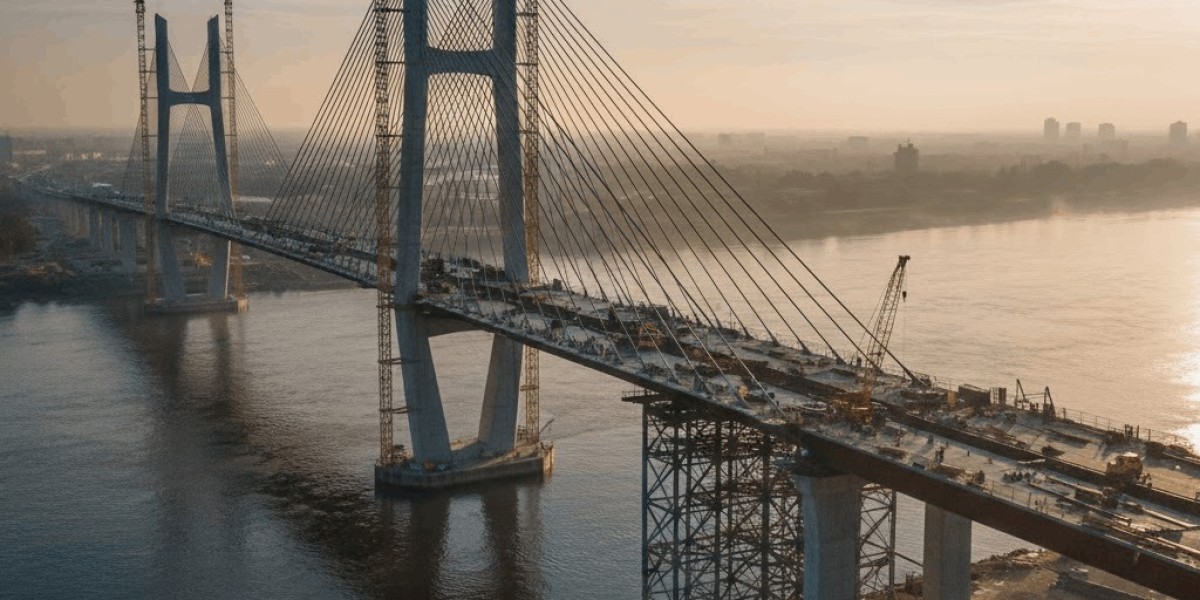

Increasing governmental funding and infrastructure stimulus packages are key drivers of the Bridge Construction Market. As countries prioritize transportation safety and connectivity, investments in both urban and rural bridge projects are expected to strengthen market growth over the coming decade.
Market Overview
Bridge construction plays a foundational role in global infrastructure development, connecting communities, enabling commerce, and supporting mobility across road, highway, and railway networks. The market encompasses a broad range of bridge types including beam bridges, truss bridges, arch bridges, suspension bridges, and cable-stayed bridges, each serving distinct structural and geographic requirements.
According to the report, the market is segmented by type, material, and application. On the materials side, steel, concrete, and composite materials represent the primary inputs driving construction activity. By application, road and highway projects dominate, though railway infrastructure is an increasingly significant growth contributor as governments invest in rail modernization and expansion.
Request Sample Pages of this Research Study @ https://www.theinsightpartners.com/sample/TIPRE00023400
Key Growth Drivers
Three major forces are identified as primary engines of market growth through the forecast period.
Innovative materials are revolutionizing how bridges are designed and built. Advances in high-performance steel alloys, ultra-high-strength concrete, and fiber-reinforced composite materials are reducing construction timelines, lowering maintenance costs, and enabling longer-span designs that were previously not feasible. These developments are prompting contractors and government agencies to rethink conventional approaches to bridge engineering.
Sustainable construction practices are also playing an increasingly important role. Environmental regulations, public awareness, and corporate sustainability mandates are pushing construction firms and infrastructure planners to adopt greener alternatives including low-carbon cement formulations and recycled steel. Bridge projects that prioritize environmental impact are gaining preferential treatment in procurement and funding processes, creating a strong incentive for industry players to align with sustainability goals.
Smart technology integration represents a third major driver. Sensors embedded in bridge structures, real-time structural health monitoring systems, and AI-driven predictive maintenance platforms are transforming how bridges are managed over their operational lifespans. By reducing catastrophic failure risks and extending service life, smart bridge technologies are attracting significant investment from both public agencies and private infrastructure funds.
Place Order for the Copy of this Report at https://www.theinsightpartners.com/buy/TIPRE00023400
Regional Insights
The report covers major regions including North America, Europe, Asia Pacific, Middle East and Africa, and South and Central America. Asia Pacific, led by China, India, and Japan, is expected to be a dominant contributor to market expansion, given the region's aggressive infrastructure investment programs and growing urbanization. North America and Europe are also key markets, where aging bridge infrastructure creates sustained demand for replacement and retrofit projects. Countries like the US, Germany, and the UK are allocating significant public funding toward bridge rehabilitation, driving both volume and value in these regions.
Competitive Landscape
The bridge construction market features a mix of global construction giants and regional specialists. Key players identified in the report include ACS Group, AECOM, Balfour Beatty, China Communications Construction Company, China Railway Group, Fluor Corporation, HOCHTIEF AG, Kiewit Corporation, Samsung C&T, and VINCI. These companies are competing on the basis of technological capability, project execution track record, and their ability to deliver on complex, large-scale infrastructure programs.
Future Outlook
Looking ahead, the market is expected to benefit from rising government spending on infrastructure modernization, public-private partnerships, and growing demand across emerging economies. Opportunities lie particularly in the development of smart bridges, the adoption of innovative composite materials, and sustainable design frameworks that align with climate commitments.
Overall, The Insight Partners' analysis paints a positive picture for the bridge construction market, defined by technological progress, policy-driven investment, and a global infrastructure renewal imperative that shows no signs of slowing through 2031.
Recent Report:
Light Gauge Steel Framing Market
Also Available in : Korean German Japanese French Chinese Italian Spanish