
In today’s fast-moving digital economy, businesses are surrounded by data—but having data alone doesn’t guarantee better decisions. Market volatility, rising customer expectations, and intense competition demand insights that are timely, accurate, and actionable. This is where Business Intelligence Consulting Services become a strategic necessity rather than a technical luxury.
Instead of relying on assumptions or fragmented reports, forward-thinking organizations leverage business intelligence to gain clarity, improve performance, and plan with confidence. With the right consulting partner, raw data is transformed into meaningful intelligence that directly supports revenue growth, operational efficiency, and long-term sustainability.
What Are Business Intelligence Consulting Services?
Business Intelligence Consulting Services help organizations design, implement, and optimize data-driven decision frameworks. These services focus on collecting data from multiple sources, organizing it into structured systems, analyzing it for insights, and presenting it in a way that supports informed decision-making at every level of the business.
Unlike basic reporting tools, BI consulting takes a strategic approach. Consultants work closely with business leaders to understand organizational goals, identify high-value metrics, and create analytics solutions aligned with measurable outcomes. This often includes:
- Centralized reporting environments
- Interactive dashboards and visual analytics
- Predictive and descriptive analytics models
- Self-service analytics for business users
By integrating technology with business strategy, BI consulting solutions help companies move from reactive decision-making to proactive planning.
Why Businesses Need a Business Intelligence Assessment
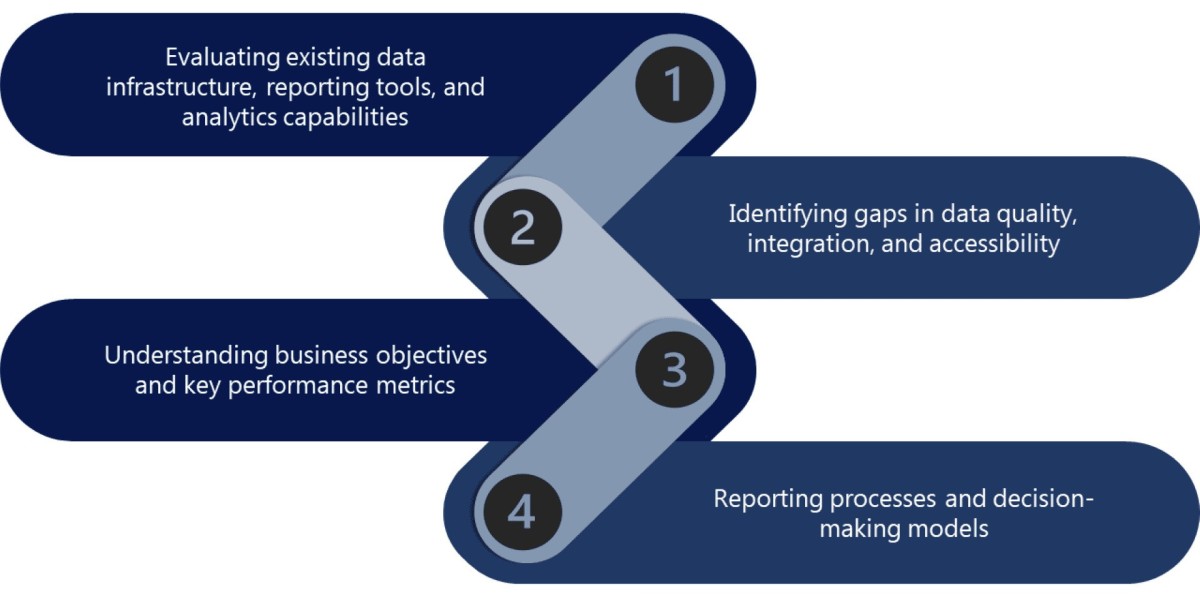
Before implementing any analytics platform, it’s essential to understand the current state of your data ecosystem. A comprehensive BI assessment evaluates data sources, reporting workflows, system integrations, and analytical maturity.
Many organizations struggle with siloed systems, inconsistent data definitions, or manual reporting processes. For example, sales, finance, and operations data may exist in separate platforms with limited visibility across teams. This fragmentation slows decision-making and increases the risk of errors.
Through a structured assessment, BI consultants identify gaps and inefficiencies while recommending scalable improvements. This foundational step ensures that investments in data management services and analytics platforms deliver maximum return and long-term value.
Aligning BI Strategy with Business Objectives
Business intelligence is most effective when it directly supports organizational goals. Data initiatives should never exist in isolation—they must be aligned with growth strategies, customer experience objectives, and operational priorities.
During this phase, consultants help organizations define key performance indicators (KPIs), prioritize use cases, and determine which insights will drive the greatest impact. For instance, a service-based company may focus on customer retention metrics, while a manufacturing firm prioritizes production efficiency and supply chain visibility.
By aligning data analytics consulting efforts with real business challenges, BI initiatives become powerful enablers of strategic execution rather than standalone technical projects.
Implementing BI Consulting Solutions for Real Impact
Successful BI adoption requires a structured and well-planned implementation roadmap. Business intelligence consultants design systems that integrate data across departments into a single source of truth.
Core implementation components typically include:
- Centralized data warehouses or analytics platforms
- Automated data pipelines for consistent and reliable data flow
- Role-based dashboards tailored to executives, managers, and analysts
- Self-service reporting capabilities to encourage user adoption
When implemented effectively, BI consulting solutions reduce manual workloads, improve data accuracy, and provide real-time visibility into business performance. Teams can focus on strategy instead of spending hours compiling reports.
The Value of Data Visualization Consulting
Even the most advanced analytics are ineffective if insights are difficult to understand. Data visualization consulting bridges this gap by translating complex datasets into clear, intuitive visual representations.
Well-designed dashboards highlight trends, reveal patterns, and surface anomalies instantly. Executives gain high-level performance snapshots, while operational teams access detailed insights relevant to their roles.
Strong visualization practices also improve cross-functional collaboration. When teams rely on a shared, visually consistent data environment, alignment improves and decisions are made faster with greater confidence.
Continuous Optimization for Long-Term Success
Business intelligence is not a one-time deployment—it’s an evolving capability. As markets shift and business priorities change, analytics platforms must adapt accordingly.
Ongoing optimization includes:
- Monitoring dashboard usage and system performance
- Refining KPIs as objectives evolve
- Enhancing predictive models for better forecasting
- Strengthening governance and data quality controls
Organizations that continuously refine their BI environments maximize the value of their Business Intelligence Consulting Services investment and maintain a competitive edge in dynamic markets.
How BI Consultants Drive Digital Transformation
BI consultants bring a unique blend of technical expertise and strategic insight. Their contributions often span multiple roles, including:
- Strategic Advisors who align data initiatives with business goals
- Data Analysts who uncover trends, risks, and opportunities
- Data Architects who design scalable and secure data models
- Visualization Experts specializing in impactful dashboards
- Analytics Specialists building predictive and prescriptive models
- Governance Leaders ensuring data accuracy, security, and compliance
Together, these capabilities ensure that analytics initiatives deliver measurable business outcomes rather than isolated reports.
Driving Growth Through Smarter Data Decisions
Organizations that invest in professional Business Intelligence Consulting Services gain more than better reporting—they gain strategic clarity. Unified data platforms improve transparency, advanced analytics strengthen forecasting, and automated insights drive efficiency across departments.
With the right combination of data management services, analytics, and visualization, businesses can respond faster to market changes, optimize resources, and build a culture of data-driven decision-making.
Ultimately, business intelligence empowers leaders to act with confidence, reduce risk, and unlock sustainable growth.
Related Blogs:-
Business Intelligence Services Give You the Power to Make Better Decisions
Frequently Asked Questions (FAQs)
1. What industries benefit most from Business Intelligence Consulting Services?
Business intelligence is valuable across industries including retail, healthcare, finance, manufacturing, logistics, and technology. Any organization managing large or complex data sets can benefit from BI consulting.
2. How do BI consulting solutions improve decision-making?
BI consulting solutions provide real-time, accurate insights through dashboards and analytics, enabling leaders to make faster, more informed decisions based on data rather than assumptions.
3. What is the difference between data analytics consulting and BI consulting?
Data analytics consulting focuses on advanced analysis and modeling, while BI consulting covers the full lifecycle—from data integration and management to reporting, visualization, and strategy alignment.
4. How long does it take to implement Business Intelligence solutions?
Timelines vary based on data complexity and business requirements, but most BI implementations range from a few weeks to several months, including assessment, design, and deployment.
5. Can BI consulting services scale as my business grows?
Yes. Modern BI platforms and consulting approaches are designed to scale, allowing organizations to add new data sources, users, and analytics capabilities as business needs evolve.
Get connected with us today to learn how to turn your data into decisions and your decisions into success!