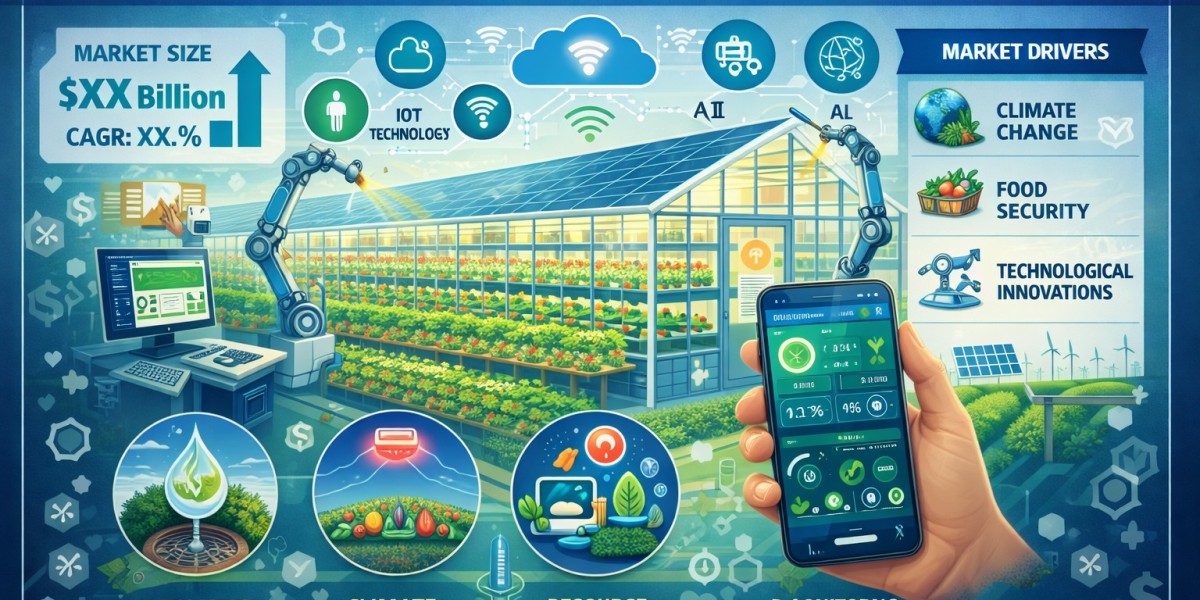

The global smart greenhouse market is on a steady growth path, anticipated to register a compound annual growth rate (CAGR) of 8.9% from 2025 to 2031, according to a forthcoming research report by The Insight Partners. This consistent expansion reflects the rising global commitment to sustainable food production, the rapid pace of urbanization demanding locally grown fresh produce, and the accelerating integration of intelligent technologies — from AI-powered climate control to LED-optimized lighting systems — into modern controlled-environment agriculture. As food security pressures intensify and climate change renders traditional open-field farming increasingly unpredictable, smart greenhouses are emerging as a critical solution for reliable, resource-efficient, year-round crop production.
Get the sample request - https://www.theinsightpartners.com/sample/TIPRE00008409
What Is a Smart Greenhouse?
A smart greenhouse is a technologically advanced controlled-environment agricultural facility that uses an integrated network of sensors, automation systems, connectivity infrastructure, and data analytics platforms to monitor and regulate the growing environment with a high degree of precision. Unlike conventional greenhouses that rely on manual observation and periodic adjustment, a smart greenhouse continuously tracks and automatically manages key variables — temperature, humidity, CO₂ levels, light intensity, irrigation, and nutrient delivery — to maintain the optimal conditions for plant growth throughout the year.
This capability to decouple crop production from external weather conditions and seasonal constraints is the fundamental value proposition of smart greenhouses. Whether deployed in temperate climates to extend growing seasons, in arid regions where water scarcity makes open-field agriculture challenging, or in dense urban environments where arable land is simply unavailable, smart greenhouses offer a controllable, scalable, and increasingly economically viable pathway to consistent, high-quality food production.
Key Market Drivers
The primary driver propelling the smart greenhouse market forward is the intensifying global demand for sustainable agriculture. Environmental sustainability has moved to the center of both consumer preference and regulatory policy, creating strong commercial incentives for farming practices that minimize resource consumption and environmental impact. Smart greenhouses are well positioned to meet this demand, as their precisely controlled environments maximize the efficiency of water and energy use while minimizing the application of pesticides and fertilizers — inputs whose overuse in conventional farming contributes significantly to soil degradation, water pollution, and greenhouse gas emissions. By delivering more crop output per unit of resource input than conventional farming approaches, smart greenhouses embody the principles of sustainable intensification that are increasingly prioritized by agricultural policymakers and institutional investors worldwide.
The second major driver is the powerful trend of urbanization and the rise of vertical farming. As global urban populations continue to grow — with the United Nations projecting that nearly 70% of the world's population will live in cities by 2050 — the logistical, economic, and environmental costs of supplying urban consumers with fresh produce transported from distant rural growing regions are coming under increasing scrutiny. Smart greenhouses are increasingly being integrated into vertical farming setups that produce crops at high density within compact urban footprints, dramatically reducing both transportation emissions and the time between harvest and consumption. This alignment between smart greenhouse technology and the urban food system transformation underway in cities across Asia, Europe, and North America is creating substantial new market opportunities for both established agricultural technology companies and emerging urban AgTech startups.
Government support and incentive programs constitute a third significant growth driver. Recognizing the strategic importance of domestic food production capacity, water conservation, and agricultural sustainability, governments in numerous countries are offering grants, subsidies, research funding, and favorable financing for the adoption of smart farming technologies including smart greenhouse systems. These policy interventions are lowering the capital cost barriers to smart greenhouse adoption, particularly for smaller commercial growers and research institutions that might otherwise lack the financial resources to invest in advanced controlled-environment agriculture infrastructure.
Market Segmentation
The smart greenhouse market is segmented across four dimensions. By type, the market is divided into hydroponic and non-hydroponic systems. Hydroponic smart greenhouses — in which plants are grown in nutrient-enriched water rather than soil — are gaining significant traction for high-value horticultural crops including leafy greens, herbs, strawberries, and tomatoes, where the precise control of nutrient delivery enabled by hydroponic systems translates directly into improved yield quality and consistency.
By covering material, the market encompasses polyethylene, polycarbonate, and other materials. Polyethylene film coverings remain widely used due to their cost-effectiveness and adequate light transmission properties for many crop types, while polycarbonate panels are preferred in installations requiring greater structural durability, superior insulation, and higher light diffusion — characteristics particularly valuable in cold climates and high-specification commercial operations.
By component, the market is categorized into HVAC systems, LED grow lights, and control systems and sensors. HVAC systems — responsible for regulating temperature and humidity within the greenhouse environment — represent a fundamental component of any smart greenhouse installation, while LED grow lights have seen explosive adoption growth as their energy efficiency, spectral tunability, and declining cost have made them the preferred artificial lighting solution for supplementary and sole-source crop illumination. Control systems and sensors form the intelligence layer of the smart greenhouse, continuously collecting environmental data and automatically adjusting operational parameters to maintain optimal growing conditions.
By end user, the market serves research and educational institutes, commercial growers, retail gardens, and other users. Commercial growers represent the largest end-user segment by revenue, driven by the scale of investment and the compelling return on investment that advanced smart greenhouse systems deliver for high-value crop production at commercial scale.
Regional Landscape
The smart greenhouse market spans North America, Europe, Asia-Pacific, South and Central America, and the Middle East and Africa. Europe has historically been a leading adopter of smart greenhouse technology, particularly in the Netherlands — home to some of the world's most technically advanced and productive greenhouse operations — as well as in Germany, the United Kingdom, France, and Scandinavia, where favorable government policies, mature agricultural technology ecosystems, and strong consumer demand for sustainably produced food have driven widespread adoption.
North America represents a substantial and growing market, fueled by the rapid expansion of commercial indoor farming operations in the United States and Canada and by increasing consumer willingness to pay premium prices for locally grown, pesticide-minimized produce. Asia-Pacific is identified as a high-growth regional market, as China, India, Japan, and Australia all invest in controlled-environment agriculture to address food security concerns, water scarcity challenges, and the growing urban consumer demand for fresh vegetables and fruits.
Competitive Landscape and Future Trends
Key players operating in the smart greenhouse market include Argus Control Systems, Certhon Build, Greentech Agro, Heliospectra, Greenhouse Megastore, LOGIQS, LumiGrow, Netafim, Nexus Corporation
Related Reports
1 Commercial Greenhouse Market
2 Greenhouse Ventilation System Market
About Us:
The Insight Partners is among the leading market research and consulting firms in the world. We take pride in delivering exclusive reports along with sophisticated strategic and tactical insights into the industry. Reports are generated through a combination of primary and secondary research, solely aimed at giving our clientele a knowledge-based insight into the market and domain. This is done to assist clients in making wiser business decisions. A holistic perspective in every study undertaken forms an integral part of our research methodology and makes the report unique and reliable.
Contact Us: If you have any queries about this report or if you would like further information, please contact us:
Contact Person: Ankit Mathur
E-mail: sales@theinsightpartners.com
Phone: +1-646-491-9876