
The Medical devices form the backbone of healthcare infrastructure, supporting everything from routine examinations to complex surgical procedures. Innovations in minimally invasive technologies and wearable systems are reshaping patient management.
Medical Devices Market Overview and Growth Trajectory
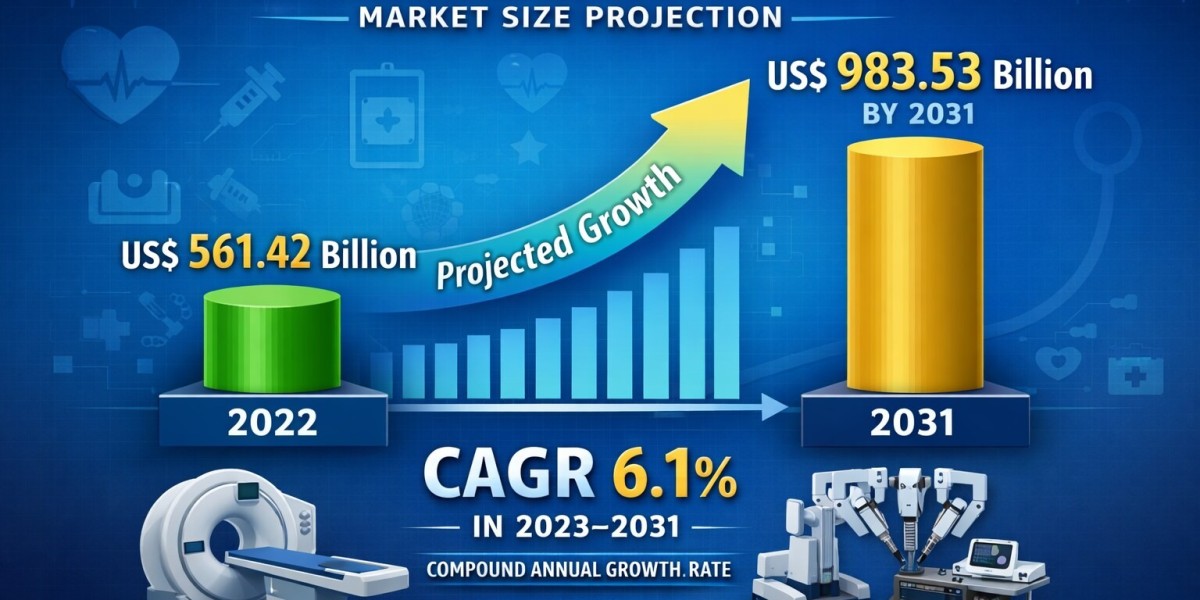
The Medical Devices Market is projected to reach US$ 983.53 billion by 2031 from US$ 561.42 billion in 2022, registering a CAGR of 6.1% during 2023 to 2031. This steady expansion reflects the growing global reliance on advanced medical technologies for diagnosis, monitoring, and treatment. Increasing healthcare expenditure, expanding hospital infrastructure, and the rising need for minimally invasive procedures are reinforcing demand across developed and emerging economies.
Healthcare systems worldwide are emphasizing early disease detection and continuous patient monitoring. As a result, medical devices that enhance clinical efficiency and improve patient outcomes are witnessing significant adoption. From surgical instruments and diagnostic imaging systems to wearable monitoring solutions, the industry is evolving rapidly to meet changing clinical requirements.
Rising Burden of Chronic Diseases Driving Demand
The increasing prevalence of chronic diseases remains a major growth catalyst. Conditions such as cancer, cardiovascular disorders, diabetes, and respiratory illnesses require long term monitoring and management supported by medical devices. For instance, a 2023 article published in A Cancer Journal for Clinicians estimated 1,958,310 new cancer cases and 609,820 cancer related deaths in the United States. Such statistics underline the urgent need for diagnostic and therapeutic equipment.
Similarly, data from the International Diabetes Federation in 2022 highlighted that nearly 2.9 million individuals in Canada were living with diabetes in 2021, with projections indicating continued growth through 2045. Chronic diseases often require glucose monitors, blood pressure devices, cardiac rhythm management systems, and respiratory support equipment. The demand for these technologies continues to rise as healthcare providers prioritize continuous disease management and preventive care.
Technological Advancements and Digital Integration
Technological innovation is reshaping the medical device landscape. The integration of artificial intelligence, connected health platforms, and Internet of Medical Things solutions has enhanced the accuracy and efficiency of medical devices. Wearable devices such as smart insulin pumps and portable cardiac monitors enable real time data tracking and remote consultation.
Manufacturers are investing heavily in research and development to introduce next generation solutions. In April 2022, Medline UNITE introduced the Calcaneal Fracture Plating System and IM Fibula Implant, designed to address complex trauma cases requiring open reduction and internal fixation. In May 2022, Stryker launched the EasyFuse Dynamic Compression System, developed using nitinol alloy to provide strength and shape recovery in surgical procedures. These innovations highlight the industry's commitment to improving surgical precision and patient recovery outcomes.
Download Sample PDF : https://www.theinsightpartners.com/sample/TIPRE00011855
Market Segmentation Analysis
The Medical Devices Market is segmented by product, function, and end user.
By product, the market includes surgical devices, in vitro diagnostic devices, general medicine devices, endoscopy devices, infection control devices, ophthalmology devices, neurology devices, and others. The in vitro diagnostic segment accounted for the largest share in 2023 due to increasing demand for laboratory testing and early disease detection.
By function, the market is categorized into diagnostic and monitoring, therapeutics, surgical, and others. The diagnostic and monitoring segment dominated in 2023, supported by rising adoption of imaging systems and wearable health monitoring technologies. However, the surgical segment is anticipated to register the highest CAGR during the forecast period owing to advancements in minimally invasive procedures.
By end user, the market is divided into hospitals and clinics, ambulatory surgical centers, and others. Hospitals and clinics held the largest market share in 2023 and are expected to maintain strong growth due to increasing patient admissions and expanding infrastructure.
Regional Insights and Competitive Landscape
North America dominates the global medical devices market, with the United States leading regional growth followed by Canada. Factors such as high healthcare expenditure, strong regulatory frameworks, advanced healthcare facilities, and the presence of major manufacturers contribute to the region's leadership. The growing geriatric population further strengthens demand for orthopedic implants, cardiovascular devices, and assistive technologies.
Europe and Asia Pacific are also experiencing steady growth, driven by healthcare modernization initiatives and expanding patient populations. Emerging markets in Asia Pacific present significant opportunities due to improving healthcare access and rising disposable incomes.
Key Players and Recent Developments
Major companies operating in the market include:
Medtronic plc
Abbott
Boston Scientific Corporation
3M
Siemens AG
Koninklijke Philips
GE
Johnson and Johnson
Recent developments include:
Max Ventilator expanded its portfolio in April 2023 with intelligent devices such as pulse oximeters, ECG systems, and monitoring solutions.
Stryker introduced the EasyFuse Dynamic Compression System to enhance surgical efficiency and implant performance.
Continuous product innovation and strategic partnerships remain key competitive strategies among leading players.
Future Outlook
The future of the Medical Devices Market appears highly promising as digital transformation, artificial intelligence integration, and personalized healthcare continue to evolve. The increasing adoption of remote patient monitoring and home healthcare solutions is expected to redefine care delivery models. Aging populations and the persistent rise in chronic diseases will sustain long term demand. Additionally, emerging economies are likely to witness accelerated growth due to infrastructure expansion and supportive healthcare policies. As innovation advances and regulatory pathways become more streamlined, the medical devices industry is poised for sustained expansion and technological progress through 2031.
Other Reports :