
The Pulmonary Function Testing Systems consist of specialized devices and software that analyze how well the lungs inhale, exhale, and transfer oxygen into the bloodstream. They are widely used in hospitals and diagnostic centers.
Pulmonary Function Testing Systems Market Analysis
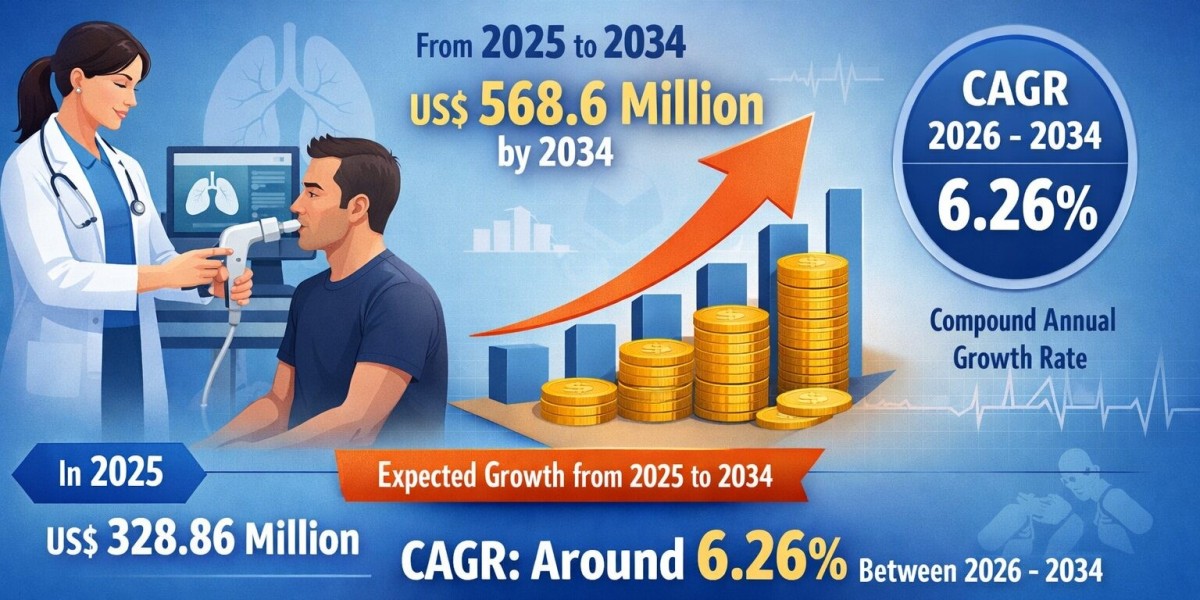
The Pulmonary Function Testing Systems Market is projected to increase from US$ 328.86 million in 2025 to US$ 568.6 million by 2034, registering a CAGR of 6.26% during 2026 to 2034. This steady expansion reflects the rising global burden of chronic respiratory diseases and the growing importance of early and accurate diagnosis. Increasing awareness about lung health, expansion of respiratory care infrastructure, and integration of advanced digital technologies are supporting long term growth across developed and emerging economies.
Healthcare providers are prioritizing preventive screening and continuous monitoring of respiratory disorders. As a result, pulmonary function testing systems are becoming essential components in hospitals, specialty clinics, diagnostic laboratories, and research institutions. The incorporation of artificial intelligence driven analytics, portable diagnostic devices, and tele respiratory monitoring platforms is further strengthening adoption across care settings.
Pulmonary Function Testing Systems Market Overview
Pulmonary function testing systems are diagnostic devices designed to measure lung capacity, airflow, gas exchange efficiency, and airway resistance. These systems perform key tests such as spirometry, lung volume measurement, diffusion capacity assessment, maximum voluntary ventilation, and oxygen titration testing. They play a critical role in diagnosing and managing conditions including chronic obstructive pulmonary disorder, asthma, restrictive lung disease, and chronic shortness of breath.
Modern systems are equipped with digital interfaces, wireless connectivity, and automated interpretation tools. These features enhance diagnostic accuracy, reduce manual errors, and streamline clinical workflows. The shift toward home based lung function assessment and cloud integrated reporting platforms is expanding their use beyond traditional hospital environments.
Market Drivers and Opportunities
Increasing Prevalence of Chronic Respiratory Diseases
The global rise in respiratory conditions such as asthma, COPD, and occupational lung disorders is a primary growth driver. Factors such as air pollution, smoking, urbanization, and aging populations are contributing to higher disease incidence. Early detection and ongoing monitoring require reliable pulmonary diagnostics, thereby increasing demand for advanced PFT systems.
Technological Advancements and Digital Integration
Innovations in portable spirometers, AI enabled interpretation software, and smartphone integrated diagnostic tools are transforming pulmonary testing. These technologies provide faster results, improved patient engagement, and enhanced clinical decision support. Integration with electronic health records and data analytics platforms enables comprehensive patient management and predictive disease assessment.
Expansion in Emerging Markets
Emerging economies such as India, China, Brazil, and countries across Southeast Asia are witnessing rapid healthcare infrastructure development. Public health initiatives focused on respiratory screening and private sector investments in diagnostic laboratories are creating substantial growth opportunities. Manufacturers are introducing cost effective and scalable systems tailored to regional requirements.
Growing Demand for Portable and Home Use Devices
The adoption of telehealth and remote monitoring is accelerating the demand for compact and cloud connected PFT systems. Home use devices empower patients with chronic respiratory diseases to monitor lung function regularly, supporting decentralized care models and reducing hospital visits.
Download Sample PDF : https://www.theinsightpartners.com/sample/TIPRE00017822
Segmentation Analysis
By type, the market is categorized into cart based PFT systems and stationary PFT systems. Cart based systems are widely used in hospitals due to their comprehensive testing capabilities, while stationary systems remain common in diagnostic laboratories.
By test type, spirometry holds a significant share due to its widespread use in routine respiratory assessment. Lung volume testing and gas exchange testing are gaining importance for advanced diagnostics. Maximum voluntary ventilation and oxygen titration tests are increasingly utilized in specialized respiratory care.
By component, the market is divided into hardware, software, and services. Hardware accounts for a substantial portion of revenue, while software and services are expanding rapidly due to demand for AI powered interpretation and maintenance support.
Regional Insights
North America holds the largest share due to advanced healthcare infrastructure, favorable reimbursement frameworks, and high diagnosis rates. The region demonstrates strong adoption of AI enabled and portable systems.
Europe maintains a significant position supported by structured healthcare systems and respiratory disease screening programs. Standardized diagnostic guidelines and digital health integration are key growth factors.
Asia Pacific is the fastest growing region, driven by increasing healthcare investments, air pollution related disease burden, and expanding diagnostic networks. Demand for affordable and portable systems is particularly strong.
South and Central America are emerging markets benefiting from public private healthcare investments and rising awareness. Cost effective spirometry devices are gaining traction among small healthcare providers.
The Middle East and Africa show promising potential due to healthcare modernization initiatives and investments in specialty respiratory clinics.
Key Players
SCHILLER
COSMED srl
MGC Diagnostics Corporation
Ganshoran Medizin Electronic
ndd Medical Technologies
Morgan Scientific Inc.
Pulm One Advanced Medical Devices Ltd
CHEST M.I., Inc
Vyaire Medical, Inc.
Koko LLC
These companies compete through product innovation, AI powered interpretation capabilities, cloud integration, and interoperability with electronic health record systems. Strategic collaborations with hospitals and expansion into emerging markets are common growth strategies.
Competitive Landscape and Business Dynamics
The market demonstrates high competitive density, with established players and emerging manufacturers focusing on technological differentiation. Companies are investing in research and development to enhance diagnostic precision and user friendly interfaces. AI driven predictive analytics and workflow automation are becoming central to product positioning.
Recent developments include next generation diagnostic software platforms with automated interpretation tools, portable wireless spirometry systems for remote monitoring, and upgraded body plethysmography solutions offering improved measurement precision.
Future Outlook
The future of the pulmonary function testing systems market appears promising, supported by continuous technological innovation and growing emphasis on early respiratory diagnosis. Increasing integration of artificial intelligence, expansion of home based monitoring solutions, and rising healthcare investments in emerging regions are expected to sustain long term growth. As healthcare systems prioritize preventive care and digital transformation, pulmonary diagnostics will play an increasingly strategic role in comprehensive respiratory management worldwide.
Other Reports :