
About QLED’s Color Volume
In the rapidly evolving world of display technology, the year 2026 has marked a pivotal shift in how we perceive digital imagery. The term "Color Volume" has transitioned from a technical specification to the definitive benchmark for premium home cinema. Unlike traditional displays that lose color accuracy as brightness increases, a modern QLED TV is engineered to maintain vibrant, lifelike hues across the entire luminance spectrum. This innovation is particularly revolutionary for viewers in Pakistan, where ambient light often challenges screen visibility. By utilizing metallic Quantum Dots, these televisions take light and transform it into a breathtaking palette of over a billion shades, ensuring that what you see on screen is exactly what the director intended, regardless of how bright your living room might be.
The Three-Dimensional Measurement of Color
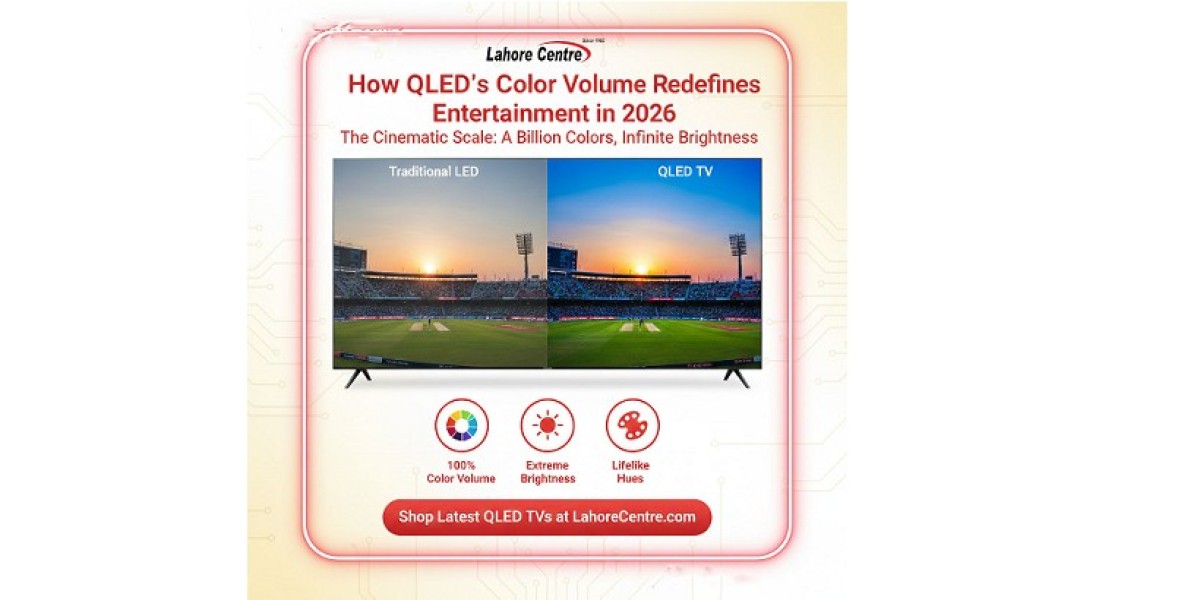
Traditional color gamut measurements only look at color in a two-dimensional space—essentially the variety of colors at a single brightness level. However, "Color Volume" adds the third dimension: brightness. A high-performance Samsung QLED TV is often verified to reach 100% color volume, meaning it can reproduce every color in the DCI-P3 cinematic color space at any level of its peak brightness. This prevents the "washed out" effect common in older sets, where a vibrant red flower might turn into a pale pink as the sun hits the screen. In 2026, this capability is the secret ingredient that makes HDR content truly "pop," providing a level of depth and realism that was previously reserved for professional grading monitors.
Hybrid Innovation: LG’s Micro RGB Evolution
While LG is synonymous with OLED, their 2026 lineup introduces a groundbreaking shift with the LG QLED technology marketed as "Micro RGB." This system combines the precision of a complete RGB backlight with a sophisticated Quantum Dot layer. By removing the standard white filter and using red, green, and blue LEDs directly, these panels achieve a color gamut coverage that competes with self-emissive displays. This "OLED-killer" approach ensures that even in rooms with 500 lux of ambient light, the blacks remain deep and the colors remain saturated. For the consumer, this means the punchy brightness of a QLED is now paired with a color accuracy that is certified for professional digital editing.
Breaking the 10,000 Nit Barrier with TCL
TCL has made waves at CES 2026 by pushing the physical limits of what a consumer screen can do. The latest TCL QLED models, specifically the X11L flagship, utilize "Super Quantum Dot" (SQD) technology paired with a Mini-LED backlight. This allows the TV to hit a staggering 10,000 nits of peak brightness. When you have this much "headroom," the color volume becomes incredibly vast. It allows for a "3D image" effect where the light itself creates layers of contrast, making objects on the screen look tangible. For sports fans in Lahore, this means the green of a cricket pitch looks as rich and textured under the bright glare of an afternoon sun as it does during a night match under the floodlights.
Haier’s Nanocrystal Technology for Local Homes
Haier has focused on making high-end color volume accessible for every household through its Nanocrystal series. A Haier QLED TV uses size-specific nanocrystals to produce cleaner shades and better detail in daily viewing. In 2026, Haier has integrated Dolby Vision IQ across its QLED range, which uses sensors to detect room lighting and adjust the color saturation in real-time. This "Intelligent Optimization" ensures that even if you are watching a dark action movie during a sunny afternoon, the TV boosts the color volume to keep the details visible. This practical application of Quantum Dot technology makes it a trending choice for users seeking a "stress-free" viewing experience without manual mode switching.
The Impact of AI on Color Expression
The hardware of a QLED is only half the story; in 2026, AI processors like Samsung’s Q4 AI or LG’s Alpha 11 Gen 3 play a crucial role in redefining entertainment. These chips use scene-by-scene analysis to identify what is on the screen—be it a sunset, a skin tone, or a neon sign—and boost the color volume accordingly. This "Color Booster Pro" technology ensures that gradients remain smooth and skin tones stay natural, avoiding the patchy look found on lower-end displays. At Lahore Centre, we demonstrate how this AI upscaling can take a standard 1080p broadcast and make it look like native 4K by intelligently filling in the color data based on the panel's vast color volume capabilities.
Why Color Volume is the Future of Home Cinema
As we move further into 2026, the demand for immersive content—from high-bitrate streaming to next-gen gaming—continues to grow. Standard LED TVs simply cannot keep up with the metadata found in modern HDR10+ or Dolby Vision 2 content. QLED’s ability to handle extreme brightness without sacrificing color integrity is why it remains the favorite for versatile home setups. It offers a "Cinematic Scale" of contrast that brings theater-quality visuals into the lounge. By choosing a panel with 100% color volume, you are essentially future-proofing your home, ensuring that your TV can handle the increasingly bright and colorful content being produced by global studios for years to come.