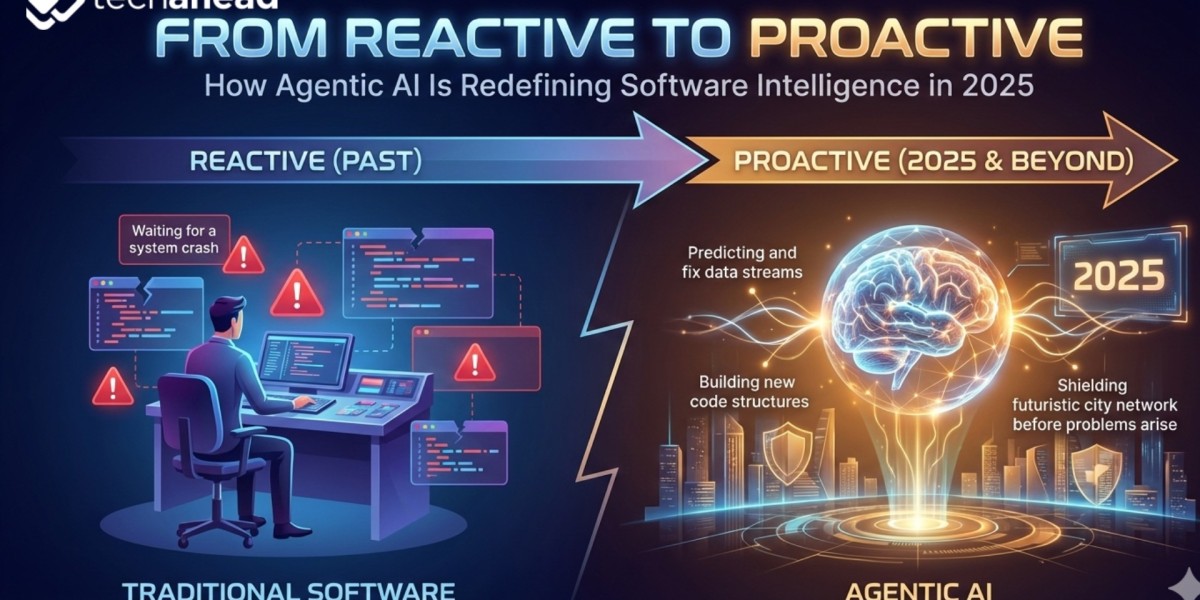

For decades, software systems have followed instructions with mechanical precision. Even the most advanced automation reacted only after a command was issued or a rule was triggered. In 2025, that limitation is disappearing fast. A new class of systems—built with Agentic AI Development Services—is enabling software to reason, plan, act, and adapt with a level of autonomy that feels fundamentally different from traditional AI.
Agentic AI is not about replacing humans. It is about building intelligent digital agents that can pursue goals, make context-aware decisions, and collaborate across tools and environments. This shift is redefining how modern businesses design products, workflows, and customer experiences.
What Makes Agentic AI Different from Traditional AI?
Traditional AI systems are largely reactive. They classify, predict, or generate outputs based on inputs. Agentic AI systems, by contrast, operate with intent. They are designed to:
Interpret high-level objectives rather than fixed commands
Break goals into executable plans
Choose tools dynamically
Learn from outcomes and refine future actions
This is why Agentic AI Development Services are becoming a strategic priority for organizations that want more than automation. They want intelligence that can operate independently within guardrails.
The Architecture Behind Intelligent Agents
At the core of agentic systems is a modular architecture. Most modern implementations include:
A reasoning engine powered by advanced large language models
A memory layer for short-term and long-term context
A planning module that sequences tasks logically
Tool interfaces that connect agents to APIs, databases, and software platforms
An experienced AI Development Agency understands how to balance these components so that agents remain reliable, explainable, and secure in production environments.
Real-World Use Cases Gaining Momentum
In 2025, agentic systems are already delivering measurable value across industries:
In enterprise operations, agents autonomously resolve IT tickets by diagnosing issues, executing fixes, and documenting outcomes.
In finance, agents monitor markets continuously and rebalance portfolios based on predefined risk strategies.
In healthcare administration, agents coordinate scheduling, insurance validation, and patient follow-ups without manual intervention.
These systems do not simply respond—they anticipate.
Why Businesses Are Investing Now
The competitive advantage of agentic systems lies in speed and adaptability. Organizations using Agentic AI Development Services report:
Faster decision cycles
Reduced operational overhead
Higher system resilience in dynamic conditions
As digital ecosystems become more complex, static automation is no longer sufficient.
Conclusion: The End of Passive Software
Agentic AI marks the transition from passive software to active digital collaborators. Companies that invest early—partnering with the right AI Development Agency—will shape the next decade of intelligent systems rather than struggling to catch up. The future belongs to software that can think, plan, and act with purpose.