
Introduction
Artificial Intelligence (AI) has moved from being a futuristic concept to a powerful force shaping today’s digital economy. Across industries, businesses are rapidly adopting AI-driven technologies to improve efficiency, enhance customer experiences, and gain a competitive advantage. From automating routine operations to enabling intelligent decision-making, Artificial Intelligence is redefining how organizations operate, innovate, and grow.
In the modern business environment, speed, accuracy, and adaptability are essential. Traditional software systems, while effective, often struggle to handle the growing volume of data and complexity of operations. Artificial Intelligence bridges this gap by enabling systems to learn from data, recognize patterns, and make predictions with minimal human intervention. As a result, AI has become a cornerstone of digital transformation strategies worldwide.
What Is Artificial Intelligence?
Artificial Intelligence refers to the simulation of human intelligence in machines that are programmed to think, learn, and perform tasks that normally require human cognition. These tasks include problem-solving, language understanding, visual perception, reasoning, and decision-making.
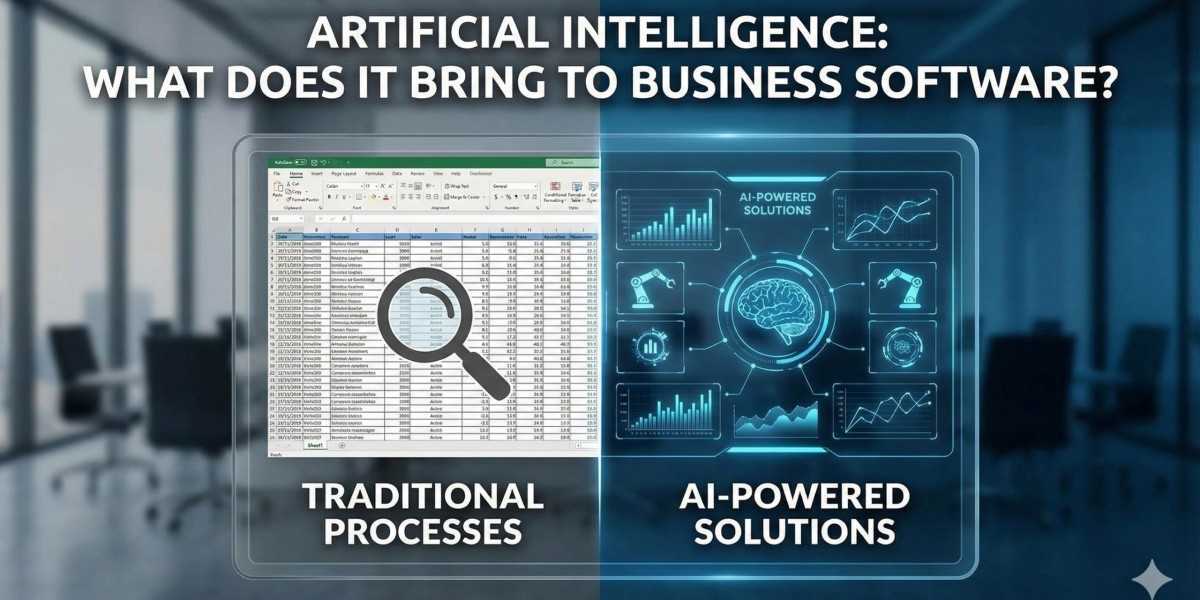
Unlike traditional software, which follows predefined rules, AI systems can adapt and improve over time through learning. This ability makes Artificial Intelligence highly valuable for businesses seeking automation, scalability, and continuous optimization.
Evolution of Artificial Intelligence in Business
The journey of Artificial Intelligence in business began with basic automation and rule-based systems. Early applications focused on simple tasks such as data processing and reporting. Over time, advancements in computing power, data availability, and algorithms led to more sophisticated AI models.
Today, AI has evolved into advanced systems capable of deep learning, predictive analytics, and generative capabilities. Businesses now use Artificial Intelligence for customer support, supply chain optimization, fraud detection, marketing personalization, and strategic planning. This evolution has made AI an integral part of mainstream business operations rather than a niche technology.
Why Artificial Intelligence Matters in Modern Software
Modern businesses generate vast amounts of data every day. Processing and analyzing this data manually is time-consuming and prone to error. Artificial Intelligence enables software systems to handle large datasets efficiently, extract meaningful insights, and support faster decision-making.
AI-powered software reduces dependency on manual effort, minimizes human errors, and ensures consistent performance. It also enables organizations to scale their operations without proportionally increasing costs. As a result, Artificial Intelligence is no longer optional—it is essential for businesses that want to remain competitive in a fast-paced digital world.
How Artificial Intelligence Enhances Business Operations
Automation of Routine Tasks
One of the most significant contributions of Artificial Intelligence is automation. AI systems can automate repetitive and time-consuming tasks such as data entry, invoice processing, scheduling, and report generation. This allows employees to focus on higher-value activities such as strategy, creativity, and innovation.
Data-Driven Decision-Making
Artificial Intelligence excels at analyzing large volumes of data and identifying patterns that may not be visible to human analysts. By providing actionable insights and predictive models, AI supports data-driven decision-making. Businesses can make informed choices based on real-time data rather than intuition or assumptions.
Predictive Capabilities
AI systems can forecast future trends by analyzing historical data. These predictive capabilities help businesses anticipate demand, understand customer behavior, identify risks, and plan resources effectively. Predictive analytics enables organizations to adopt a proactive approach rather than reacting to problems after they occur.
Enhanced User Experience and Personalization
Artificial Intelligence improves user experience by personalizing interactions and services. AI-driven systems analyze user preferences, behavior, and history to deliver tailored recommendations and communications. Personalized experiences lead to higher customer satisfaction, engagement, and loyalty.
Types of Artificial Intelligence Used in Business
Machine Learning
Machine Learning enables systems to learn from data and improve performance without explicit programming. Businesses use it for forecasting, recommendation systems, anomaly detection, and performance optimization.
Natural Language Processing
Natural Language Processing allows machines to understand and respond to human language. It powers chatbots, virtual assistants, sentiment analysis tools, and document summarization systems.
Computer Vision
Computer Vision enables AI systems to interpret images and videos. It is widely used in quality control, inventory management, facial recognition, and surveillance applications.
Robotic Process Automation
RPA automates rule-based digital tasks such as form filling, data migration, and system integration. When combined with AI, RPA becomes more intelligent and adaptable.
Generative Artificial Intelligence
Generative AI creates new content such as text, images, code, and designs. Businesses use it for marketing content, product descriptions, software development, and creative ideation.
AI-Driven Features in Modern Business Software
Artificial Intelligence has introduced several intelligent features in business software, including:
AI-powered chatbots and virtual assistants for customer support
Predictive analytics dashboards for strategic planning
Automated workflows for task management and approvals
Recommendation engines for products and services
Fraud detection and cybersecurity monitoring systems
These features enhance efficiency, accuracy, and responsiveness across business functions.
Industry-Specific Applications of Artificial Intelligence
Finance and Banking
In the financial sector, Artificial Intelligence is used for fraud detection, credit scoring, risk assessment, algorithmic trading, and customer service automation.
Healthcare
AI supports medical imaging analysis, patient data management, predictive diagnostics, and personalized treatment planning, improving accuracy and patient outcomes.
Retail and E-Commerce
Retailers use AI for demand forecasting, personalized shopping experiences, inventory optimization, and dynamic pricing strategies.
Manufacturing and Supply Chain
Artificial Intelligence enables predictive maintenance, quality control, supply chain visibility, and operational optimization in manufacturing environments.
Human Resources
In HR, AI assists with resume screening, candidate matching, performance analysis, attendance tracking, and workforce planning.
Benefits of Artificial Intelligence Integration
The integration of Artificial Intelligence offers numerous benefits, including:
Increased productivity and operational efficiency
Reduced costs and optimized resource utilization
Improved strategic planning and risk management
Enhanced customer engagement and satisfaction
Stronger competitive advantage and scalability
Businesses that adopt AI effectively can adapt quickly to market changes and drive sustainable growth.
Challenges and Risks of Artificial Intelligence
Despite its advantages, Artificial Intelligence also presents challenges:
Data quality and integration issues
Security and privacy concerns
Ethical and regulatory considerations
Bias and lack of transparency in AI models
Workforce displacement and skill gaps
Addressing these challenges requires responsible implementation, continuous monitoring, and investment in employee training and upskilling.
Best Practices for Implementing Artificial Intelligence
To successfully implement Artificial Intelligence, businesses should:
Clearly identify business objectives and use cases
Select scalable and compatible AI tools
Ensure high-quality, compliant data
Train employees and promote AI literacy
Continuously monitor, evaluate, and improve AI systems
A strategic and ethical approach ensures maximum value from AI investments.
The Future of Artificial Intelligence in Business
The future of Artificial Intelligence is marked by deeper integration, increased automation, and stronger collaboration between humans and machines. Businesses will increasingly rely on autonomous AI systems capable of handling complex workflows with minimal supervision.
At the same time, human intelligence will remain essential for ethical judgment, creativity, and strategic vision. The most successful organizations will be those that balance technological innovation with human values.
Conclusion
Artificial Intelligence is transforming businesses by enabling smarter operations, faster decision-making, and personalized experiences. As AI continues to evolve, its role in the digital economy will only expand. Organizations that embrace Artificial Intelligence responsibly and strategically will be better positioned to navigate challenges, seize opportunities, and achieve long-term success in an increasingly competitive world.