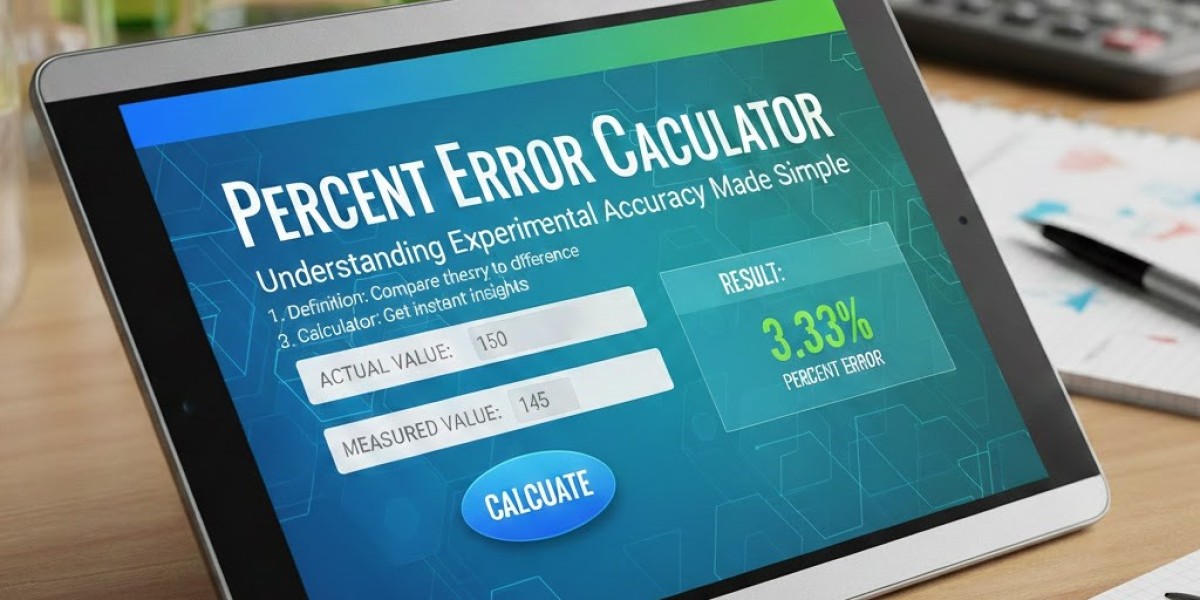

Accuracy is at the heart of scientific learning. Whether you are working in a school laboratory, completing an academic assignment, or analyzing data for a project, knowing how close your results are to the accepted value is essential. This is where a Percent Error Calculator becomes incredibly useful. With tools like the Percent Error Calculator, students and learners can instantly evaluate experimental accuracy without struggling through repetitive calculations. When used correctly, this simple tool turns complex error analysis into a clear and manageable task.
What Is Experimental Accuracy?
Experimental accuracy refers to how closely an experimental result matches the accepted or true value. In scientific studies, results rarely come out perfectly due to limitations in tools, human observation, or environmental conditions.
Accuracy helps answer an important question: How reliable is this result?
Accuracy vs Precision
Many students confuse accuracy with precision, yet they serve different purposes.
Accuracy shows closeness to the true value
Precision shows consistency across repeated measurements
A result can be precise without being accurate, and vice versa. Percent error focuses specifically on accuracy, making it a vital concept in science education.
Understanding Percent Error in Simple Terms
Percent error expresses the difference between an experimental value and an accepted value as a percentage. This allows easy comparison across different experiments and scales.
The Basic Percent Error Formula
Percent Error = |Experimental Value − Accepted Value| ÷ Accepted Value × 100
This formula ensures that:
Errors are always positive
Results are easy to interpret
Differences are standardized
While the formula is not difficult, applying it repeatedly can be time-consuming and prone to mistakes.
Why Percent Error Matters in Science and Education
Percent error is not just another calculation—it plays a critical role in scientific thinking.
Evaluating Experimental Results
Percent error allows students to judge whether an experiment was successful or needs improvement. A lower percent error generally indicates better accuracy.
Identifying Sources of Error
High percent error encourages deeper analysis, such as:
Instrument limitations
Measurement technique issues
Environmental interference
Every percent error tells a story about the experiment.
Common Challenges Students Face with Percent Error
Despite its importance, percent error is often misunderstood.
Calculation Errors
Students frequently make mistakes such as:
Forgetting absolute value
Dividing by the wrong number
Rounding too early
Mixing up experimental and accepted values
These errors can distort final results and affect grades.
Time Pressure in Labs and Exams
In practical sessions, students must calculate percent error multiple times within limited periods. Manual calculations can slow progress and increase stress.
What Is a Percent Error Calculator?
A Percent Error Calculator is a digital tool that automatically computes percent error using the standard formula. Users simply enter the required values, and the result is generated instantly.
How It Simplifies Learning
Instead of focusing on arithmetic steps, students can focus on:
Understanding why errors occur
Interpreting the significance of results
Improving experimental methods
The calculator handles the math, so learners can handle the thinking.
How a Percent Error Calculator Improves Experimental Accuracy
Although calculators do not improve the experiment itself, they improve how accuracy is measured and understood.
Eliminates Repetitive Mistakes
Since the formula is applied automatically, common calculation errors are avoided. This leads to more reliable results.
Encourages Consistency
When analyzing multiple trials, consistency matters. A calculator ensures each calculation follows the same method, making comparisons fair and meaningful.
Real-Life Applications of Percent Error Calculations
Percent error is not limited to classrooms. It has real-world relevance across multiple fields.
Science Laboratories
In physics and chemistry labs, percent error is used to assess:
Measurement accuracy
Reaction outcomes
Equipment reliability
Engineering and Technology
Engineers use percent error to test system performance, safety margins, and tolerance limits.
Medical and Environmental Studies
Accurate data is critical in healthcare and environmental research. Percent error helps verify reliability before decisions are made.
Learning the Concept Before Using the Tool
While calculators are helpful, conceptual understanding remains essential.
Building a Strong Foundation
Students should first learn:
Why percent error exists
How the formula works
What the results mean
Once this understanding is in place, calculators enhance efficiency rather than replace learning.
Using Calculators as Verification Tools
A smart learning approach is to calculate manually once, then verify using a calculator. This reinforces understanding and builds confidence.
Improving Lab Reports with Percent Error Calculators
Lab reports often require detailed analysis, not just calculations.
Saving Time for Critical Thinking
By reducing calculation time, students can spend more effort on:
Discussing sources of error
Suggesting improvements
Explaining discrepancies
This leads to higher-quality reports and stronger scientific reasoning.
Presenting Cleaner Results
Accurate calculations result in cleaner data tables and clearer conclusions, which improves overall academic presentation.
Trust, Reliability, and Digital Tools in Science
Modern science relies on trusted digital tools to manage complexity.
Accuracy Builds Trust
Reliable percent error calculators apply formulas consistently, increasing trust in results.
Supporting Academic Integrity
Correct calculations ensure honest reporting, which is essential for ethical science and education.
Trustworthy tools support trustworthy learning.
Why Simplicity Matters in Scientific Learning
Science can be challenging, especially for beginners. Simplifying processes without losing meaning helps students stay engaged.
Reducing Cognitive Overload
When students are not overwhelmed by calculations, they can better absorb concepts and develop analytical skills.
Encouraging Curiosity
Fast, accurate calculations allow learners to experiment with different values and explore outcomes more freely.
Preparing Students for Advanced Scientific Work
Higher education and professional research environments rely heavily on digital tools.
Bridging the Gap Between Learning and Practice
Using calculators responsibly mirrors real-world scientific workflows, where efficiency and accuracy go hand in hand.
Developing Analytical Confidence
When students trust their calculations, they approach analysis with greater confidence and clarity.
Final Thoughts: Making Experimental Accuracy Easy to Understand
Percent error is a foundational concept that helps students evaluate accuracy, learn from mistakes, and improve scientific methods. While understanding the formula is essential, repeatedly calculating percent error by hand can slow learning and introduce unnecessary errors.
A Percent Error Calculator makes experimental accuracy easier to understand by delivering quick, reliable results. It allows students to focus on interpretation, reasoning, and improvement—the true goals of science education.
When accuracy becomes simple to measure, learning becomes easier to master.