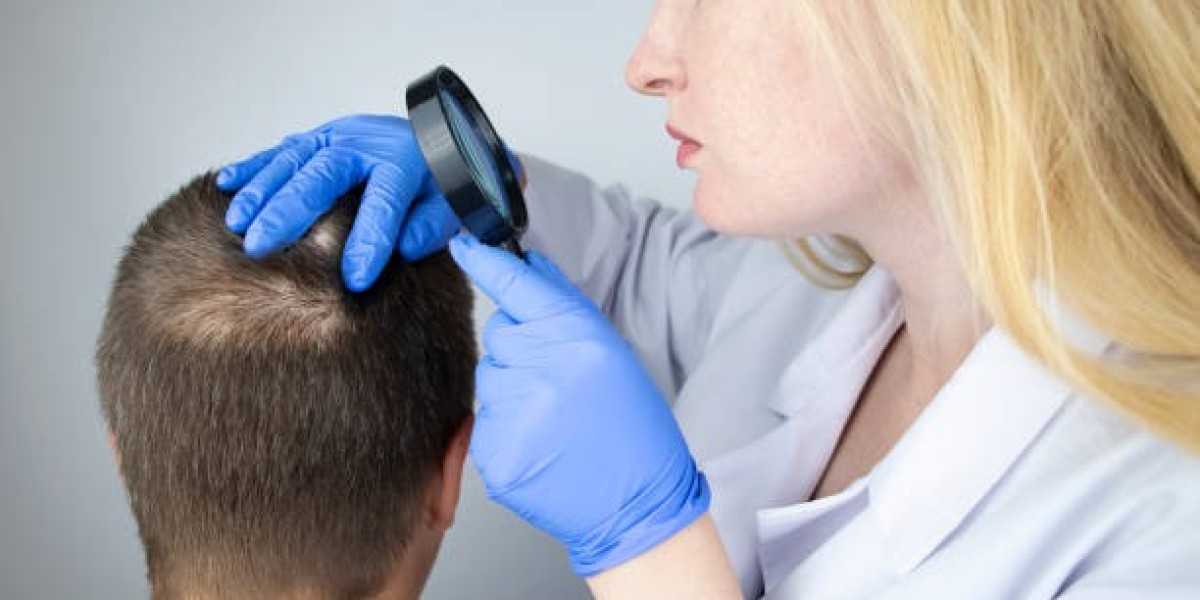

Patchy hair loss, the most common manifestation of Alopecia Areata, presents as distinct, smooth, "coin-sized" bald spots that can appear overnight. Because the patches are localized, the clinical strategy focuses on high-intensity, site-specific interventions. Alopecia Areata Treatment in Dubai for patchy loss is designed to "boundary-map" the affected areas, treating not just the bald center but the active margins where the immune system is currently expanding. By stabilizing these patches through targeted medical and aesthetic protocols, practitioners can stop the progression and trigger uniform regrowth across the entire affected zone.
Mapping the "Active Margin" of a Patch
How do clinicians determine if a patch is still growing?
In clinical settings, we observe that the "edge" of the patch is more important than the center. During an examination, we perform a "perimetric pull test." If hairs at the edge of the smooth spot come out easily, the patch is in an active spreading phase. High-resolution trichoscopy is then used to look for "exclamation point hairs" (short, broken hairs that are wider at the top). Identifying these markers allows us to concentrate treatment at the perimeter, effectively "quarantining" the patch to prevent it from merging with other spots or expanding across the scalp.
What Does Patch-Specific Treatment Feel Like?
What are the real sensations of localized therapy?
The primary treatment for patchy loss involves intralesional injections of anti-inflammatory medication directly into the bald spot. You will feel a series of quick, localized "pinches"—usually 4 to 6 per patch. Because the medication is being placed in the dermis, there is a sensation of "pressure" or "fullness" that lasts for about 60 seconds. On a pain scale of 1 to 10, most patients rate this as a 3. The scalp may feel slightly "tight" for the remainder of the day, but there is no lingering pain or need for downtime.
"I had three circular patches on the back of my head. I was worried the injections would be painful, but it was just a few quick taps. It felt like someone was flicking my scalp with a finger. The best part was seeing the 'white fuzz' fill in those circles just six weeks later."
— Kareem
The Recovery Timeline for Patchy Regrowth
How long until the smooth skin is covered by hair?
Recovery for patchy loss is measured by the transition of the skin texture and the emergence of new shafts:
Days 1–7: The "Calming Phase." Any itching or tingling in the patch subsides as the immune swarm is suppressed.
Weeks 4–6: The "Shadow Phase." Fine vellus hairs (peach fuzz) appear. These are often white or translucent initially.
Months 2–4: The "Pigmentation Phase." The new hair gains its natural color and thickness, starting from the edges and moving toward the center.
Month 6: The "Integration Phase." The patch is fully filled and matches the length and density of the surrounding hair.
Comparing Patchy Loss Treatment Strategies
| Clinical Goal | Intralesional Injections | Aesthetic Camouflage (SMP) |
| Primary Function | Biological regrowth | Visual concealment |
| Downtime | 24 hours | 2–4 days |
| Initial Sensation | Minor pinch (3/10) | Light scratching (3/10) |
| Time to "Fix" | 2–4 months (Growth) | Immediate (Visual) |
| Ideal For | Active, small patches | Stable patches or slow regrowth |
Technical Insights: The "Grid Injection" Technique
How do practitioners ensure even coverage across a patch?
Information gain for patchy loss patients lies in the "injection geometry." In our clinical observations, simply injecting the center of a patch is ineffective. Practitioners use a "grid-mapping" technique, spacing injections approximately 1cm apart across the entire smooth area and extending 5mm into the hair-bearing margins. This ensures that the medication reaches every suppressed follicle. The concentration of the medication is also adjusted; if a patch is "older" and the skin has become thinner, we use a more diluted solution to prevent the risk of localized skin atrophy (denting).
FAQs:
Can one patch turn into total hair loss?
While most patchy cases remain localized, about 5% of patients may progress to more extensive loss. Early "boundary-mapping" and treatment of patches are the best ways to reduce this risk by quieting the systemic immune response.
Should I shave my head if I have multiple patches?
Many patients choose a "buzzed" look to make the patches less obvious during treatment. This also makes it much easier for the clinician to apply topical medications or perform injections with 100% accuracy.
What if I get a new patch while treating an old one?
This is common as the autoimmune condition can fluctuate. We simply add the new patch to the treatment protocol. It does not mean the first treatment is failing; it just means the immune system is still active.
Is patchy loss caused by fungal infections?
No. While fungal infections (tinea capitis) can look similar, Alopecia Areata is autoimmune. A clinical exam can easily distinguish the two: Alopecia leaves the skin smooth, while fungal infections usually cause scaling and redness.
Why Choose Tajmeels Clinic
Patchy hair loss is a high-visibility issue that requires a high-precision solution. At Tajmeels Clinic, we specialize in the "Quarantine and Restore" method for Alopecia Areata Treatment in Dubai. We don't just treat the bald spots you see; we use advanced trichoscopy to find "pre-clinical" patches before they become visible to the naked eye. Our clinicians combine medical-grade injections with biostimulants and aesthetic options, ensuring that your patches are managed from every angle. By choosing our clinic, you are opting for a detailed, diagnostic-heavy approach that focuses on stopping the spread and bringing your natural hair back as fast as biologically possible.










